At some point, almost every business runs into the same question: how do you want this bound? It sounds simple, but the binding method you choose has a real effect on how your finished book looks, how it holds up over time, and how easy it is for the reader to actually use.
Perfect binding and coil binding are two of the most popular options for professionally printed books. Both produce sharp, finished results – but they serve different purposes. Knowing which one fits your project saves you time, money, and a few headaches down the road.
This guide walks through exactly how each method works, what it is good at, where it falls short, and how to decide which one makes sense for what you are printing.
What Is Perfect Binding?
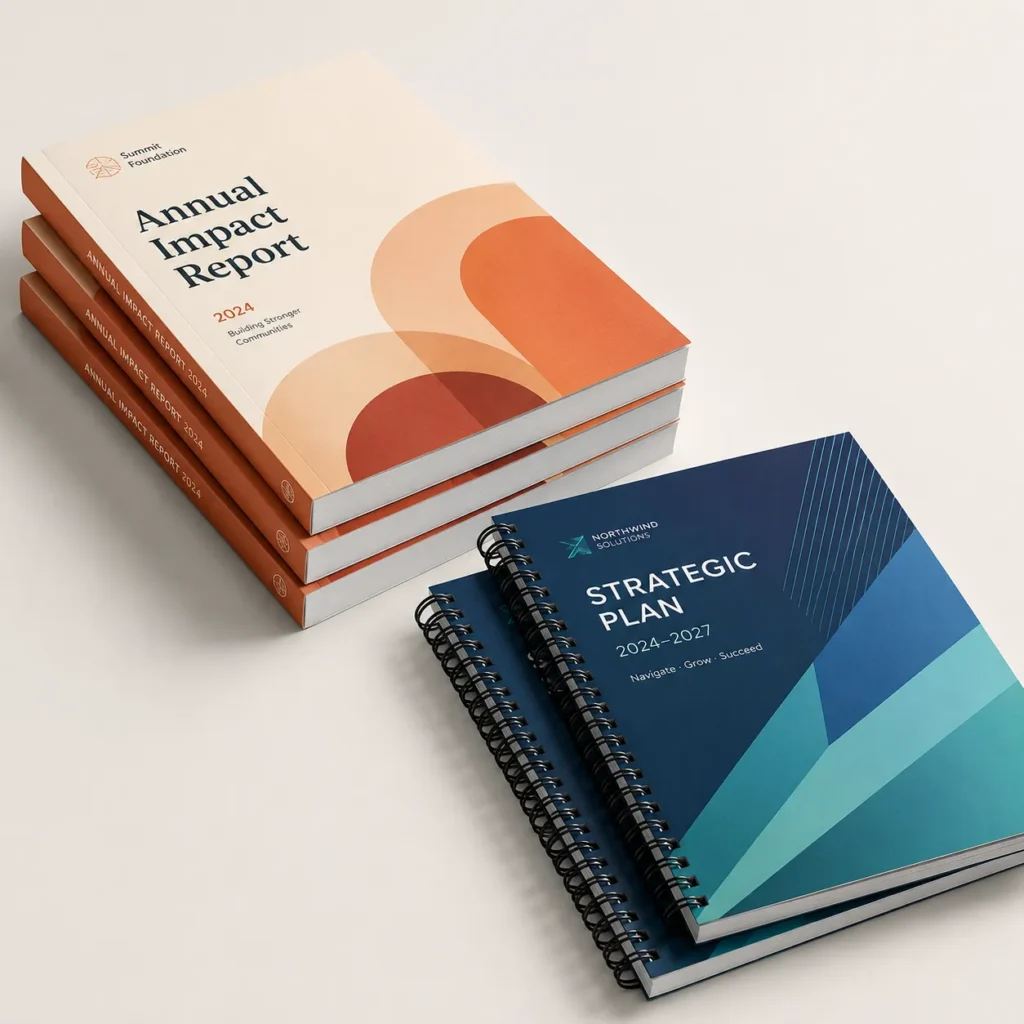
Perfect binding is the method used for most trade paperback books, catalogs, and magazines. The pages are gathered into a text block, the spine edge is ground slightly to create a rough surface, and then a strong adhesive is applied. A wraparound cover is glued to the spine and folds around the front and back, creating a flat, clean finished edge.
The result looks familiar because you see it every day. Pick up a novel from a bookstore, a product catalog from a vendor, or a college textbook and that is almost certainly a perfect bound book. The spine is flat, can carry printed text or a logo, and gives the publication a polished, retail-quality appearance.
Perfect binding works best for higher page counts – typically 48 pages or more – because the spine needs enough thickness to hold the adhesive and give the cover something to grip. Thinner books tend not to have enough spine width to work well with this method.
What Perfect Binding Is Good For
- Product catalogs and lookbooks
- Company annual reports
- Corporate directories and membership guides
- Sales and rate books
- Insurance and benefits booklets
- Novels, poetry collections, and literary publications
- Real estate market reports
- Church and nonprofit publications
If your book needs to sit on a shelf or be displayed in a rack, perfect binding is the right call. The printable spine means the title and your company name are visible even when the book is shelved, which matters for anything you are distributing to clients or selling at events.
What Is Coil Binding?
Coil binding – sometimes called spiral binding – works differently. Once the pages are printed and trimmed, a series of holes are punched along the binding edge. A continuous plastic or metal coil is then threaded through those holes, and the ends are crimped to lock it in place.
The main advantage is function. A coil bound book opens completely flat on a table, and can actually be folded all the way back on itself so the reader only sees the page they are working from. That is a significant practical benefit for anyone using the book as a reference while doing something else with their hands.
Coil binding is also flexible when it comes to page count. You can coil bind a thin 16-page booklet just as easily as a thick 300-page manual. The coil simply gets thicker or thinner based on how many pages you are working with.
What Coil Binding Is Good For
- Employee training and operations manuals
- Course workbooks and student handouts
- Planners, appointment books, and calendars
- Technical reference guides
- Cookbooks and recipe booklets
- Price guides and product specification books
- Sales presentation books
- Art portfolios and photography books
The coil itself is available in a range of colors, which gives you some control over the finished look. Black, white, and clear are standard options. Silver metal coil is also available and works well for presentations or portfolios where a more professional appearance matters.
A Side-by-Side Comparison
Here is a quick reference to help clarify where each method fits:
| Feature | Perfect Bound | Coil Bound |
| Appearance | Flat printed spine; retail-quality look | Coil visible on spine edge; functional look |
| Lay flat ability | No – holds shape like a book | Yes – opens completely flat |
| Page count range | Best at 48+ pages | Works from 8 pages and up |
| Spine can be printed on | Yes | No |
| Durability in the field | Good; pages can loosen with heavy use | Excellent; coil holds through repeated use |
| Best for | Catalogs, reports, directories, publications | Manuals, workbooks, planners, cookbooks |
How to Choose the Right Binding for Your Project
The best way to approach this decision is to think about how the person receiving your book is actually going to use it. A catalog that sits on a client’s desk or gets filed on a shelf has different requirements than a training manual that a new employee flips through at their workstation every day.
Choose perfect binding when:
- Your book has 48 or more pages
- Shelf presence and a printable spine matter to your project
- You want a retail-quality or publication-style appearance
- The book is primarily read front to back rather than used as a flat reference
- You are distributing to clients, attendees, or the public and want a strong first impression
Choose coil binding when:
- Your book needs to lie completely flat on a desk or workstation
- Readers will flip back and forth between sections frequently
- The book will be used in hands-on environments like kitchens, warehouses, or training rooms
- Your page count is under 48 pages
- You want to update content periodically and may reprint in short runs
- You are producing a planner, workbook, or instructional guide
There are also cases where both options could work and it genuinely comes down to preference. A 60-page sales presentation book, for example, could go either way. Perfect binding gives it a more formal, finished look. Coil binding makes it easier for the sales rep to reference without fumbling with pages. Neither answer is wrong – it depends on which quality matters more for that specific use.
Paper and Cover Choices Matter Too
Binding method is one piece of the equation. Paper selection and cover finishing also have a significant impact on the final result.
For perfect bound books, cover weight is important. A 100 lb. or heavier cover stock gives the book a sturdy feel and holds the glued binding together properly. Cover laminate options – gloss, matte, or soft-touch – affect both appearance and durability. A gloss laminate cover pops with color and resists fingerprints reasonably well. A matte laminate has a more subdued, sophisticated look. Soft-touch is a premium option that has a velvety feel and is especially popular for high-end catalogs and reports.
For coil bound books, cover weight matters for the front and back panels, but there is a bit more flexibility since the coil itself provides structure. Many coil bound books use a clear or frosted acetate front cover with a heavier card stock back cover to protect the interior pages.
Interior paper stock affects readability and print quality. Heavier coated paper handles color photography and graphics better. Uncoated paper is easier to write on, which is important for workbooks or planners where the reader fills in information. Recycled or uncoated offset stocks work well for text-heavy reference guides.
If you are not certain which paper or cover option fits your project, a good print shop can show you physical samples and help you pick based on your content and how the book will be used.
What About File Setup?
One thing that catches people off guard with perfect binding is the cover file setup. Because the spine is printed, the cover is actually one continuous file that wraps around the front, spine, and back as a single panel. The width of the spine depends on the page count and the paper stock being used, so you need an accurate final page count before setting up the cover artwork.
For a 100-page book printed on 60 lb. text paper, the spine width might be around a quarter inch. For a 300-page book on heavier stock, it could be closer to three-quarters of an inch. Your print shop can calculate the exact spine width once you have confirmed your final page count and paper selection.
Coil binding does not have this complexity. The cover is simply a front panel and a back panel, sized to the trim dimensions of the book. No spine calculation needed, which makes it a bit more forgiving when it comes to file prep.
Both binding methods require proper bleed on any content that runs to the edge of the page. Typically, a 0.125-inch bleed on all sides is standard. If you are setting up files in InDesign, Illustrator, or a similar program, building the bleed into your document from the start saves time and avoids having to revise files before production.
Printing in Deerfield Beach and South Florida
Print Basics has been producing professional bound books for businesses throughout Deerfield Beach, Pompano Beach, Boca Raton, Fort Lauderdale, Boynton Beach, and the surrounding South Florida area for over 20 years. We work with businesses of all sizes – from small teams that need 25 copies of a training manual to large organizations running thousands of catalogs for trade shows and events.
Our team handles the full production process in-house: prepress, printing, binding, and delivery. If you are not sure which binding method is right for your project, bring us a draft or a sample page and we can help you figure it out. We can also provide printed samples of both binding styles so you can hold them in your hands before making a decision.
Short runs are not a problem. We can print as few or as many copies as your project requires, and our digital printing capabilities make short-run perfect bound and coil bound books cost-effective even at quantities that would have been impractical a decade ago.
Ready to Print Your Book?
Whether you need a crisp perfect bound catalog for your next sales call or a rugged coil bound training manual for your team, Print Basics can help you get it done right. We are based in Deerfield Beach and serve businesses throughout South Florida.
Contact us to get a free quote, or stop by to see samples of both binding styles in person. Our team is ready to help you figure out exactly what your project needs.


